
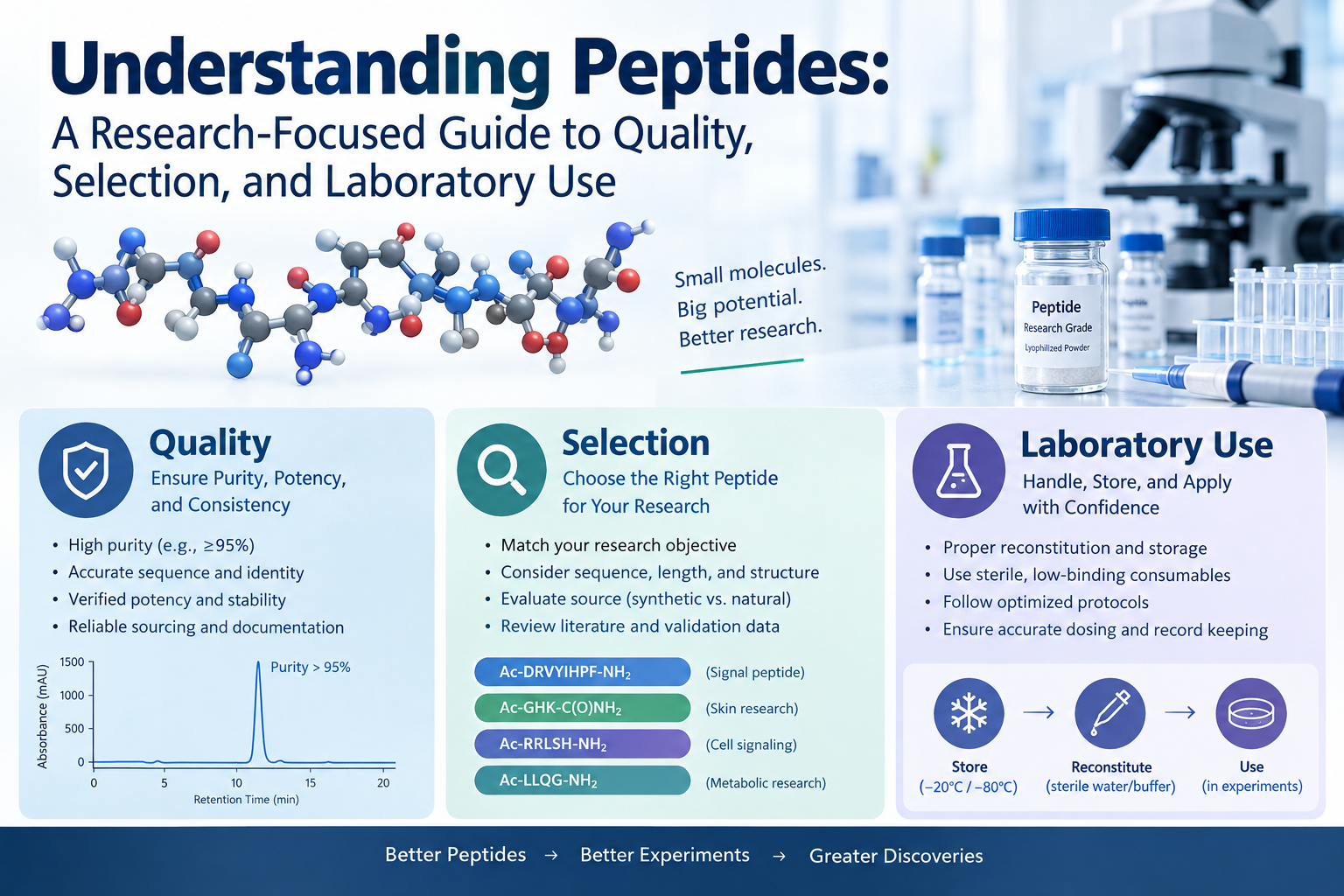
Peptide research has become an important part of modern molecular and biological science. Researchers use synthetic peptide compounds to investigate receptor interactions, cellular signaling, metabolic pathways, protein activity, and other complex biological mechanisms. As the range of available compounds continues to expand, selecting an appropriate research material requires careful attention to its chemical characteristics, analytical documentation, and intended application.
When researching Peptidos, it is useful to look beyond the name of a compound. Laboratory professionals can evaluate factors such as molecular identity, purity, analytical testing, batch documentation, storage requirements, and supplier transparency. These details can make a significant difference when researchers need consistent and traceable materials for experimental work.
What Are Peptides?
Peptides are molecules made from amino acids connected by peptide bonds. They are smaller than most proteins but can perform highly specific biological functions depending on their amino acid sequence and molecular structure. Synthetic peptides can be produced for laboratory research and may be designed to interact with particular receptors, proteins, or signaling pathways.
The biological behavior of a peptide depends on several characteristics, including its sequence, length, structural configuration, chemical modifications, and molecular target. This is why researchers typically need detailed information about a compound before incorporating it into an experimental protocol.
Why Are Synthetic Peptides Used in Research?
Synthetic peptides provide researchers with controlled molecular tools for investigating specific biological questions. Instead of studying an entire biological system without isolating individual mechanisms, scientists can use defined compounds to explore particular pathways or molecular interactions.
Depending on the research objective, peptide compounds may be investigated in areas including:
- Receptor signaling and molecular pharmacology
- Metabolic pathway research
- Cellular communication
- Protein and peptide interactions
- Neurobiological research
- Growth hormone-related pathways
- Cellular and tissue research models
- Structure-function investigations
Key Factors When Evaluating a Research Peptide
Selecting a research compound should be based on measurable and documented characteristics. A product description alone may not provide enough information for laboratory decision-making. Researchers should consider several technical factors before choosing a material.
Molecular Identity
Molecular identity helps establish whether the material corresponds to the compound that is listed by the supplier. Analytical techniques such as mass spectrometry can be used to compare an observed molecular mass with the expected theoretical value.
Purity
Purity is another important parameter in peptide characterization. High-performance liquid chromatography, commonly known as HPLC, can be used to separate components within a sample and evaluate the relative presence of the primary compound and other detectable substances.
Batch Information
Batch or lot identification provides an important connection between the physical material and its supporting documentation. Researchers can use this information when maintaining laboratory records, comparing experimental results, or reviewing materials used during a particular study.
The Role of HPLC in Peptide Characterization
HPLC is a widely used analytical method in chemistry and pharmaceutical research. In peptide analysis, chromatographic separation can provide useful information about sample composition. Researchers may examine chromatographic profiles when assessing the purity characteristics of a synthetic compound.
However, purity should not be viewed as the only measure of material quality. A more complete evaluation can involve multiple analytical parameters, including chromatographic results, molecular-mass information, batch identification, and supporting documentation.
Mass Spectrometry and Molecular Confirmation
Mass spectrometry can complement chromatographic analysis by providing information about molecular mass. This can help researchers assess whether the measured characteristics of a sample are consistent with the expected molecular structure.
Combining different analytical approaches is particularly useful when the objective is to establish a clearer profile of a research compound. Reliable analytical information can also support better laboratory documentation and experimental reproducibility.
Examples of Peptide Research Categories
Peptide research covers numerous molecular pathways. Some compounds are investigated for their relationship with metabolic receptors, while others are studied in connection with growth hormone signaling, cellular mechanisms, or other biological targets.
Metabolic Signaling
GLP-1R, GIPR, and GCGR are examples of receptors associated with metabolic research. Compounds such as semaglutide, tirzepatide, and retatrutide may be investigated in scientific models examining receptor activity and related signaling mechanisms.
Growth Hormone Pathways
Research involving the growth hormone axis can include compounds associated with GHRH and related receptors. Materials such as CJC-1295, sermorelin, and tesamorelin are examples of compounds that may be examined in laboratory research concerning these pathways.
Cellular Research
Other peptide compounds may be investigated in cellular or tissue-related models. Examples can include BPC-157, TB-500, KPV, and GHK-Cu. The interpretation of experimental findings depends on the research model, study design, controls, and available scientific evidence.
How Should Researchers Compare Suppliers?
Supplier selection is an important part of laboratory procurement. Researchers should look for companies that communicate clearly about the nature of their materials and provide appropriate technical information for research purposes.
For researchers comparing Peptidos, useful supplier-evaluation criteria include documentation quality, analytical testing, batch traceability, stated purity, storage instructions, and clarity regarding the intended research use of each compound.
- Check whether batch-specific documentation is available.
- Review stated purity and analytical testing information.
- Look for molecular identity data where applicable.
- Confirm recommended storage conditions.
- Evaluate the transparency of the supplier’s product information.
- Maintain certificates and batch records with laboratory documentation.
Why Documentation Matters in Laboratory Research
Scientific research depends heavily on reproducibility and accurate recordkeeping. When researchers know exactly which compound and batch were used in an experiment, it becomes easier to document procedures and investigate unexpected results.
A Certificate of Analysis, or COA, can support this process by connecting analytical information to a specific lot. Depending on the material, a COA may include details related to purity, identity, batch number, and testing parameters.
Frequently Asked Questions
What is a research peptide?
A research peptide is a peptide compound supplied for scientific investigation. It can be used as a laboratory tool for studying molecular interactions, biological pathways, receptor activity, and other research questions. Its intended use should always be verified with the supplier’s documentation.
Why is peptide purity important?
Purity provides information about the composition of a sample and can be an important consideration when selecting research materials. It should be evaluated alongside molecular identity and other analytical information.
What does HPLC tell researchers?
HPLC can help separate components within a sample and provide information used to assess chromatographic purity. It is commonly used as part of analytical characterization.
Why should researchers keep batch records?
Batch records improve traceability by connecting experimental work to a specific material. This can make laboratory documentation more organized and support the review of experimental results.
Conclusion
Peptide research involves a broad range of scientific applications, from receptor signaling and metabolic pathways to cellular and molecular investigations. Because different compounds have different structures and research characteristics, selecting a material requires careful evaluation rather than relying solely on product names or marketing descriptions.
Researchers can make more informed procurement decisions by reviewing molecular identity, HPLC purity, mass-spectrometry information, batch traceability, Certificates of Analysis, and storage requirements. A documentation-focused approach helps laboratories maintain organized records and supports the broader goal of reliable, reproducible scientific research.